7 Ways to Brew Whole Bean Coffee at Home Without a Grinder
Last Updated: November 5, 2026
Quick Summary
You can brew whole bean coffee at home without a grinder by cracking the beans coarsely first, since whole beans dropped straight into water barely release flavor. Use a blender, food processor, rolling pin, or mortar and pestle, then steep a little longer than usual.
- Crack beans to roughly the size of coarse sea salt, not powder.
- Add roughly 30 to 60 seconds to your usual steep time.
- Use two tablespoons of cracked beans per six ounces of water.
- Let water rest about 30 seconds after boiling before pouring.
- Cold brew steeps overnight with cold water for a smoother, lower-acidity cup.
Table of Contents
- Start With Great Beans and the Right Tools
- How to Brew Whole Bean Coffee at Home Without a Grinder
- How to Brew Whole Bean Coffee at Home Without a Machine
- The Whole Bean Coffee Brewing Ratio That Actually Works
- Can You Brew Whole Coffee Beans in a Coffee Maker?
- What to Expect From the Flavor
- Pick Your Roast and Start Your Morning Ritual
- Frequently Asked Questions
Start With Great Beans and the Right Tools
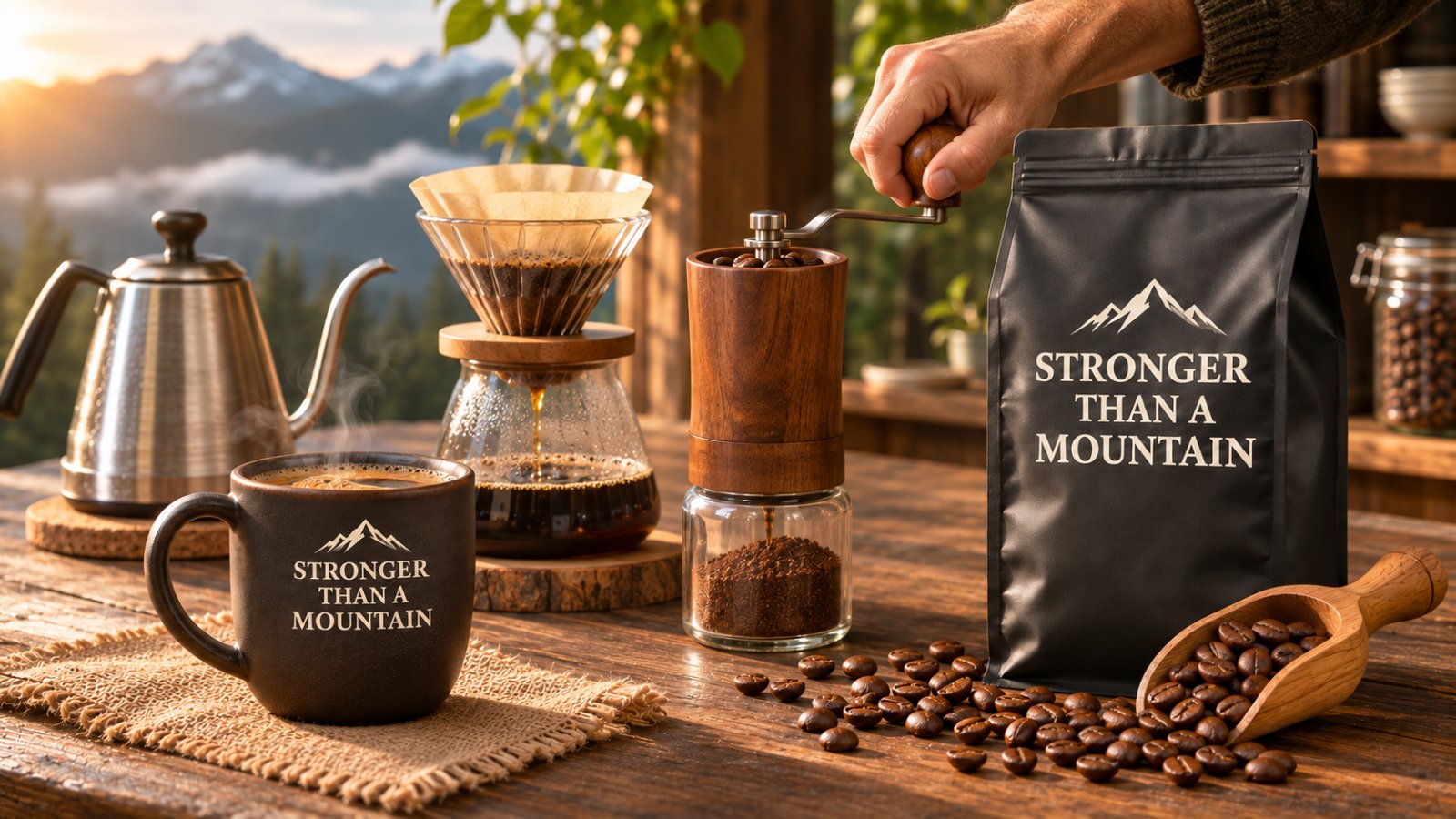
You can brew whole bean coffee at home without a grinder, and the results are better than most people expect. The trick is understanding what grinding actually does, then working around it. At Stronger Than A Mountain, we roast in small batches and hear the same question every week: what if I bought whole beans but never got the grinder? This guide answers that.
Whole bean coffee is roasted coffee that has not been ground, which keeps the oils and aroma sealed inside each bean until the moment you break it open. That protection is why we ship our Signature Whole Bean Blends as whole beans by default. Once a bean is cracked, it starts losing character within hours.
Here is what you actually need on the counter:
- Fresh whole beans, ideally roasted within the last few weeks
- A way to break the beans, even a rough one
- Filtered water
- A kettle or pot you can control
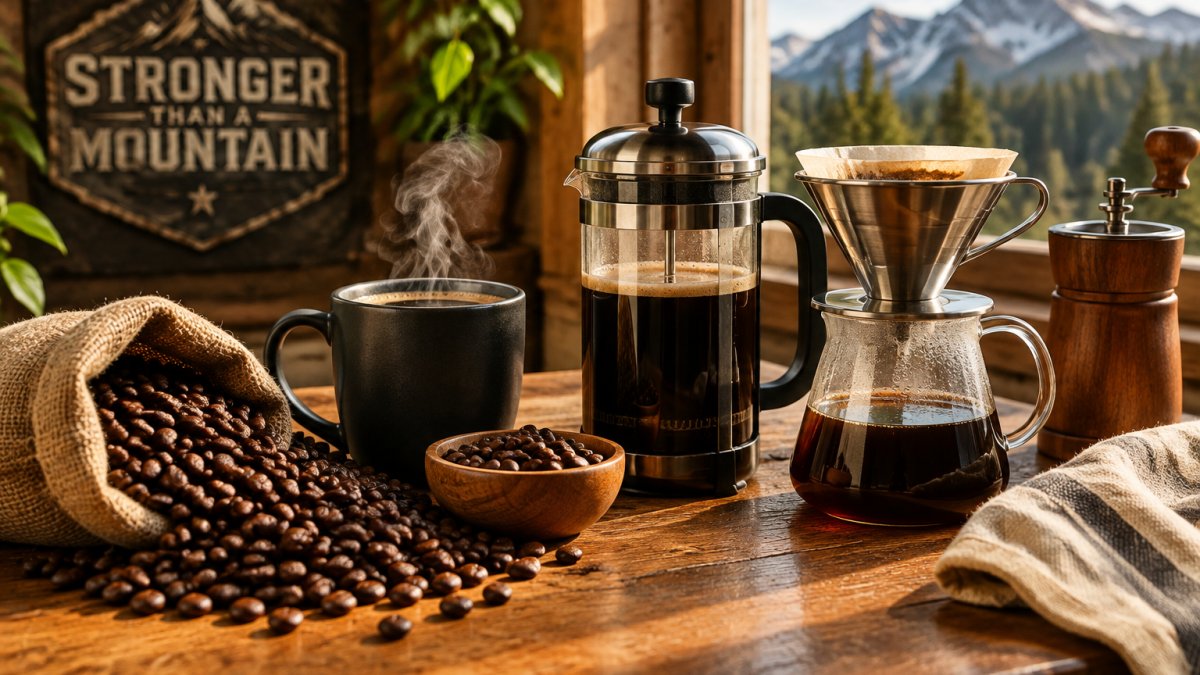
- A steeping vessel: French press, jar, or mug
Everything else is optional. Specialty Coffee Association brewing guidance notes that grind consistency and water quality drive most of what lands in the cup, and neither requires expensive gear.
If you want to start with quality beans, explore our small-batch coffee collection and pick a bag size that fits your counter space. For a deeper look at sto
rage and selection, our guide on choosing and keeping fresh roasted beans covers what this section only introduces.
How to Brew Whole Bean Coffee at Home Without a Grinder
Yes, you can brew whole bean coffee at home without a grinder, but you have to break the beans first. Whole beans dropped straight into water barely give up their flavor because the water only touches the outside. Extraction depends on surface area, and a whole bean offers very little.
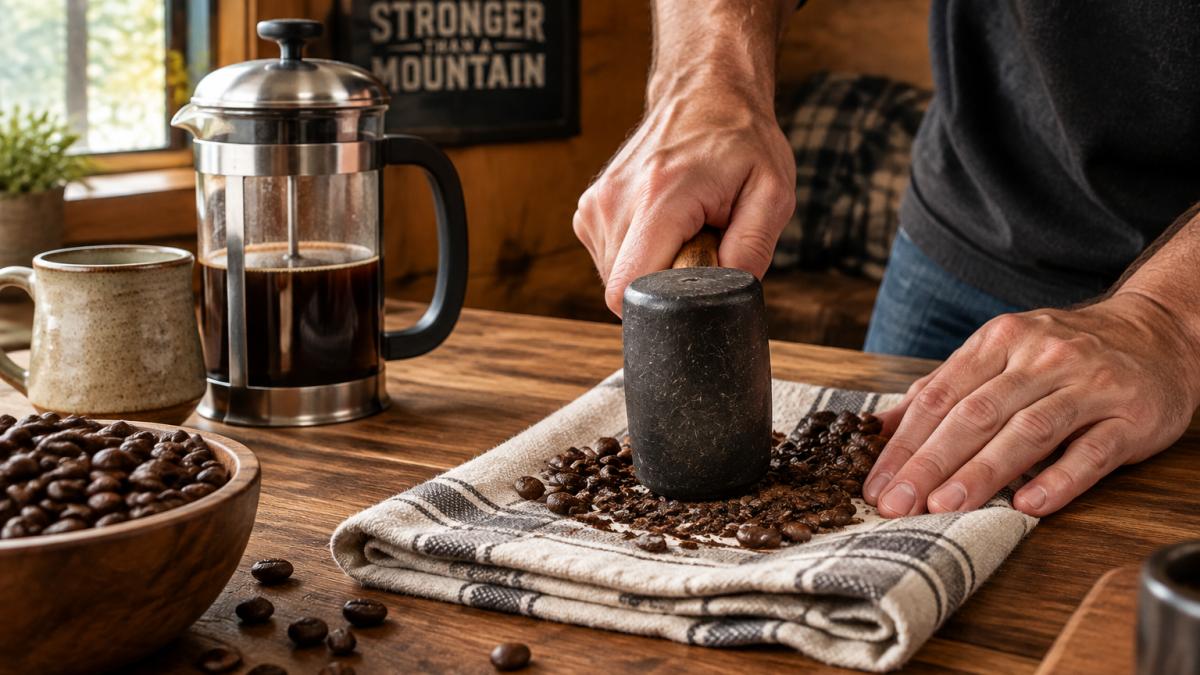
So the plan is simple: crack the beans coarsely, then brew a little longer than you would with ground coffee. Coarse pieces release flavor slowly, which means more steeping time and a bit more patience.
- Expect a rougher, more uneven grind than a burr grinder gives you
- Add roughly 30 to 60 seconds to your usual steep time
- Stir once at the start so water reaches every piece
- Let the grounds settle before you pour or press
DIY Grinder Alternatives You Already Own
Your kitchen already holds several workable grinders. None are perfect, but each gets you to a coarse, usable crack.
- Blender. Pulse in short bursts, two seconds at a time. Stop before it turns to powder.
- Food processor. Same idea, fewer pulses. Watch for fine dust at the bottom.
- Rolling pin or mallet. Seal beans in a zip bag or folded towel, then press and roll.
- Mortar and pestle. Crush in small batches for the most control.
- Hand-crank mill. If you own one for spices, it handles coffee fine in small amounts.
A common mistake is over-processing. Ten seconds in a blender gives you powder, and powder clogs filters and turns bitter fast. Aim for pieces roughly the size of coarse sea salt.
How to Brew Whole Bean Coffee at Home Without a Machine
You can brew whole bean coffee at home without a machine using nothing more than a jar, hot water, and a strainer. This is immersion brewing at its simplest, and it forgives an uneven grind better than any pour-over method.
Here is the process, start to finish:
- Crack about two tablespoons of beans coarsely.
- Add them to a jar or French press.
- Pour in hot water, just off the boil.
- Stir once, then cover and wait four to five minutes.
- Let the pieces settle for a minute.
- Pour slowly through a fine strainer or press the plunger down gently.
Watch out: pouring boiling water straight from the kettle scalds the coffee and brings out bitterness. Let it rest for about 30 seconds after boiling.
Cold brew works the same way with cold water and a much longer steep, usually overnight. It produces a smoother, lower-acidity cup, which suits darker roasts well.
The Whole Bean Coffee Brewing Ratio That Actually Works
The whole bean coffee brewing ratio we recommend is two tablespoons of cracked beans per six ounces of water. That lands close to the standard starting point most brewing guides use, and it gives you room to adjust. Because cracked beans extract slower and more unevenly than ground ones, start slightly stronger than you normally would.
A kitchen scale removes the guesswork. Two tablespoons of coarsely cracked beans weighs roughly 10 to 12 grams depending on how fine your crack runs, and six ounces of water is about 177 milliliters. If you want a repeatable cup, weigh both.
Brew Method | Beans | Water | Steep Time |
|---|---|---|---|
French press | 2 tbsp (about 11 g) | 6 oz (about 177 ml) | 4-5 min |
Jar immersion | 2 tbsp (about 11 g) | 6 oz (about 177 ml) | 4-5 min |
Cold brew | 1 cup (about 85 g) | 4 cups (about 950 ml) | 12-18 hrs |
Coffee maker | 2 tbsp (about 11 g) | 6 oz (about 177 ml) | Full cycle |
Use filtered water. Tap water with heavy minerals flattens aroma, and chlorine covers the top notes entirely. Water makes up almost the whole cup, so it deserves the same attention as the beans. Temperature matters too: aim for water just off the boil, around 195 to 205 degrees Fahrenheit.
Brew Your Strength. Wear Your Story. →
Dialing in is a three-cup process, and it is the fastest way to learn your own setup. Brew your first cup at the starting ratio. If it tastes weak or watery, crack the beans a little finer or add half a tablespoon more. If it tastes harsh or drying, back off the beans or shorten the steep by 30 seconds.
Cold brew is the forgiving exception. With a long overnight steep, the ratio matters less because time does the work, and a coarser crack keeps the concentrate clean. Dilute the finished concentrate to taste with water or milk before serving.
Can You Brew Whole Coffee Beans in a Coffee Maker?
You can brew whole coffee beans in a coffee maker, but only after cracking them. Whole beans in a drip basket mostly waste good coffee. Water runs past the bean surface in seconds and leaves the interior untouched.
Crack the beans coarsely, load the filter, and run your machine as usual. Because the pieces are uneven, expect a slightly weaker cup than you get with a uniform grind. Add a little extra coffee to compensate, and use a permanent filter if you have one; paper filters catch fine dust but can slow the draw-down.
Freshness matters here more than anywhere. Beans release gas for days after roasting, and that degassing is why fresh coffee blooms when water hits it. Our article on the difference 24 to 48 hours makes explains why timing your brew around roast date changes the cup.
What to Expect From the Flavor
Expect a lighter body, a cleaner finish, and a slower build of flavor than you get from a uniform fine grind. The trade-off is real: some of the deeper, syrupy notes stay locked inside the pieces you never fully cracked.
Here is the mechanism, because it explains everything else in this guide. Extraction is a surface-area problem. Water can only dissolve compounds it touches, and a whole bean exposes almost none of its interior. Grinding multiplies that exposed surface by orders of magnitude, which is why a burr grinder is the single biggest upgrade most brewers can make.
That is also why bitterness is less of a risk with a rough crack than with a fine grind. Over-extraction pulls harsh, woody compounds out of the bean, and it happens fastest when particles are tiny and uniform. Big uneven pieces extract unevenly, which sounds like a flaw but actually protects you from the bitter edge.
Flavor notes shift with the roast too, and this is where the bean you choose matters more than the crack you give it. A dark roast like Dark Temptation brings a deep, rich profile to a coarse steep. Wild at Heart is a fruit-forward, aromatic roast that shines in a coarse steep. Sunrise Renegade is our morning blend.
- Coarse crack (coarse sea salt size): brighter cup, cleaner finish, more aroma up front, thinner body
- Fine crack (table salt size): heavier body, more sediment, easier to over-extract and turn bitter
- Whole bean, uncracked: weak and thin, not recommended, the water never reaches the interior
Agitation matters as well. Stir once at the start so every piece gets wet, then leave it alone. Constant stirring pushes extraction toward bitterness and clouds the cup with micro-grounds that slip past your strainer. If your first cup tastes thin, the fix is usually a finer crack and a slightly longer steep, not more beans.
Pick Your Roast and Start Your Morning Ritual
The best way to learn how to brew whole bean coffee at home is to pick a roast you love and brew it the same way three mornings in a row. Small changes add up fast, and a rough crack is a fine place to start.
For a dark, comforting cup, shop Dark Temptation coffee. If you lean toward bright, fruit-forward coffee, browse Wild at Heart coffee.
Our six signature roasts, Sunrise Renegade, Buckwild Black, Dark Temptation, Blue Collar Brew, Wild at Heart, and Rebel Gold, are shipped nationwide. Every creation deserves the same care we would want given to our own most meaningful memories.
Frequently Asked Questions
Can you brew whole bean coffee without grinding?
Yes, though the cup will taste different. Whole beans have far less surface area, so water pulls out fewer flavor compounds. You can brew whole bean coffee by steeping them longer in a French press, simmering them in a pot, or crushing them with a mallet or blender first. Expect a lighter body and less intensity than a ground batch, but with good beans and a longer steep, it still makes a drinkable, aromatic cup.
What is the best whole bean coffee brewing ratio?
A reliable starting point is about 1 to 2 tablespoons of coffee per 6 ounces of filtered water, then adjust to taste. When you brew whole bean coffee without grinding, use slightly more beans and a longer steeping time to make up for the reduced surface area. If the cup tastes weak, add beans first; if it turns bitter, shorten the steep rather than adding more coffee.
Can you put whole coffee beans in a coffee maker?
You can, but a standard drip coffee maker is built for ground coffee. Whole beans will not extract fully in a normal brew cycle, so the result is usually thin and underwhelming. If you want to brew whole coffee beans in a coffee maker, crush them coarsely first with a blender or mallet, or use a machine with a built-in grinder. Otherwise, a French press or stovetop pot handles whole beans far better.
How many whole coffee beans do you need for one cup?
Roughly 30 to 40 whole beans make a single 6-ounce cup, depending on the bean size and how strong you like it. That is about the equivalent of 1 to 2 tablespoons of ground coffee. When you brew whole bean coffee at home without grinding, lean toward the higher end and steep longer, since intact beans release flavor more slowly than ground coffee does.
Your morning cup does not need a grinder, a machine, or a perfect setup. It needs good beans, hot water, and five quiet minutes. Start with a bag of our small-batch coffee, crack the beans coarse, and taste the difference fresh roasting makes. Browse our signature blends and find the roast that fits your ritual, with local care and nationwide shipping behind every order.